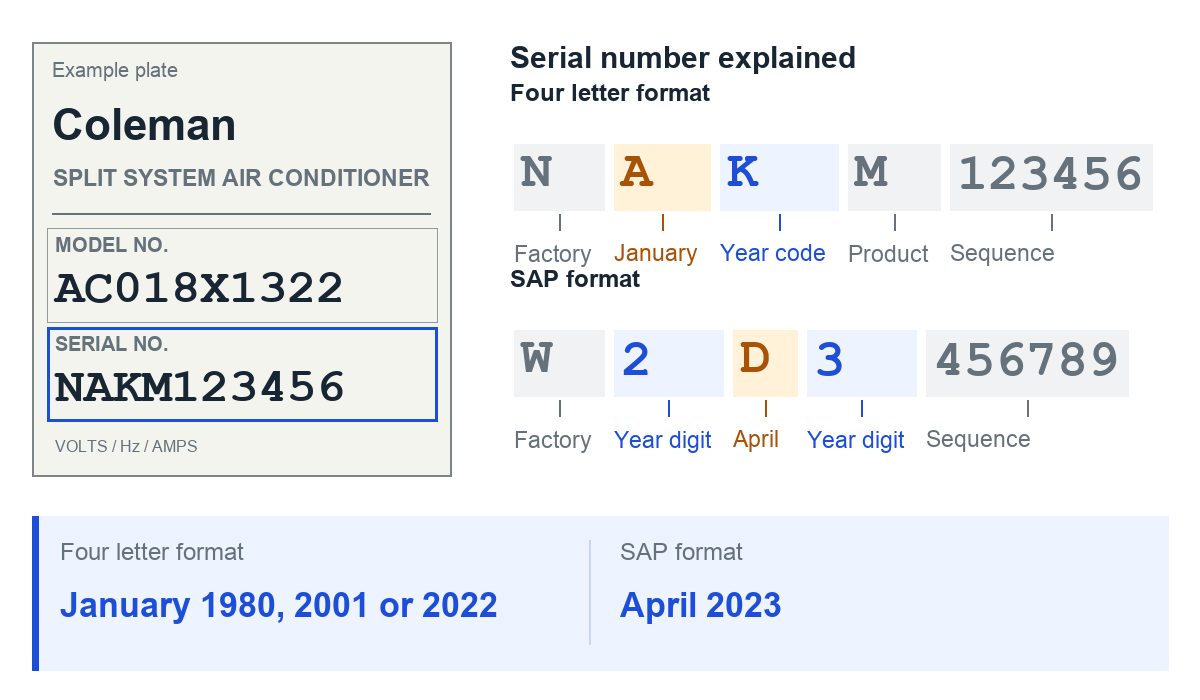
For example, split serial number NAKM123456 as N | A | K | M | 123456. N is the factory letter, A means January, K can mean 1980, 2001, or 2022, M identifies the product type, and 123456 is the unit sequence. The serial number alone cannot show which 21-year cycle applies, so Appliage returns all three January dates. Entering the Coleman model number does not choose between them.
The SAP structure begins with a letter, a digit, a month letter, and another digit. Positions 2 and 4 combine to form the last two digits of the year, while position 3 gives the month. For example, split serial number W2D3456789 as W | 2 | D | 3 | 456789. W is the factory letter, the digits 2 and 3 form 23 and mean 2023, D means April, and 456789 is the unit sequence. Therefore, this serial number gives April 2023. Appliage checks both structures and returns one manufacture month when the year is unique or every date allowed by a repeating year letter.
Appliage decodes two Coleman date structures, and both give a month and year. In the SAP structure, position 1 is the factory, position 3 is the month letter, and positions 2 and 4 combine into the last two digits of the year. In the structure that starts with four letters, position 2 is the month letter and position 3 is a year letter that repeats every 21 years. Coleman Age Rules below has both tables.
Go by the opening characters, not by an assumed changeover year. Four letters at the start use the repeating letter table and can give dates 21 years apart. A letter, digit, letter, digit opening uses the SAP structure and gives one year.
Coleman Serial Number Rules
| Coleman structure | Factory field | Year field | Month field | Other fields |
|---|---|---|---|---|
| Legacy letter structure | Position 1 | Position 3: repeating year letter | Position 2: month letter | Position 4 is product type; remaining characters are the unit sequence |
| Later SAP structure | Position 1 | Positions 2 and 4: combine the two digits | Position 3: month letter | Remaining characters are the unit sequence |
- legacy 1 factory letter
- legacy 2 month letter
- legacy 3 21-year cycle letter
- legacy 4 product type
- SAP 1 factory letter
- SAP 2 + 4 year
- SAP 3 month letter
- remainder unit sequence
The factory letter identifies where the equipment was made. In the legacy structure, position 4 identifies the product type. The remaining characters identify the individual machine. These fields do not influence the manufacture date.
Coleman Month Codes
| Month code | Manufacture month |
|---|---|
| A | January |
| B | February |
| C | March |
| D | April |
| E | May |
| F | June |
| G | July |
| H | August |
| K | September |
| L | October |
| M | November |
| N | December |
Both Coleman structures use this month table. The table skips I and J, so K means September and L means October.
Legacy Coleman Year Letters in Position 3
| Year letter | First cycle | Second cycle | Third cycle |
|---|---|---|---|
| A | 1971 | 1992 | 2013 |
| B | 1972 | 1993 | 2014 |
| C | 1973 | 1994 | 2015 |
| D | 1974 | 1995 | 2016 |
| E | 1975 | 1996 | 2017 |
| F | 1976 | 1997 | 2018 |
| G | 1977 | 1998 | 2019 |
| H | 1978 | 1999 | 2020 |
| J | 1979 | 2000 | 2021 |
| K | 1980 | 2001 | 2022 |
| L | 1981 | 2002 | 2023 |
| M | 1982 | 2003 | 2024 |
| N | 1983 | 2004 | 2025 |
| P | 1984 | 2005 | 2026 |
| R | 1985 | 2006 | 2027 |
| S | 1986 | 2007 | 2028 |
| T | 1987 | 2008 | 2029 |
| V | 1988 | 2009 | 2030 |
| W | 1989 | 2010 | 2031 |
| X | 1990 | 2011 | 2032 |
| Y | 1991 | 2012 | 2033 |
In that structure, the year letters repeat every 21 years. Johnson Controls publishes all three columns shown above. Appliage leaves out any candidate that is later than today.
Later Coleman SAP Year Digits
| Positions 2 and 4 | Manufacture year | Example opening |
|---|---|---|
| 0 and 7 | 2007 | W0G7 |
| 0 and 9 | 2009 | W0H9 |
| 1 and 6 | 2016 | W1L6 |
| 2 and 6 | 2026 | W2A6 |
The second character is the tens digit, and the fourth character is the ones digit. For example, W2D3456789 contains 2 and 3, which form 23 and therefore mean 2023.
Coleman Serial Numbers Appliage Cannot Find the Age
A legacy serial number must begin with four letters and use valid month and year letters from the tables above. A later SAP serial number must begin with a letter, digit, valid month letter, and digit. If the serial number matches neither structure, Appliage returns no manufacture date.
Coleman serial numbers from before 1971 and unrelated structures made only of digits cannot be decoded with these rules. Entering the model number does not provide a missing date code or choose among the repeating year cycles.
If a year letter produces more than one date, use a dated installation, purchase, service, recall, or factory record to identify the correct year. The manufacture date can be earlier than the installation date and warranty start date.
Why Coleman Uses the York Serial System
A federal furnace recall names York International as the maker and lists Coleman furnaces beside York and Luxaire, with their shared serial groups on the notice. This shared production history explains why Coleman and York rating plates use the same older and SAP date structures.
This connection applies to Coleman heating and cooling equipment, not Coleman camping products. Equipment sold under the York name uses the same two structures.
Sources
- Johnson Controls serial number reference (SI0418). The reference explains both serial formats and their year and month letters. Archived copy.
- UPG furnace service letter (ST-028-07). The letter includes a residential furnace serial with a known date. Archived copy.
- UPG furnace service letter (ST-045-09). A second residential furnace serial appears in this service letter.
- Coleman warranty and registration
- York warranty and registration
- CPSC: York, Luxaire and Coleman furnace recall (01-523)
- CPSC: York Diamond 80 furnace recall (00-003). The recall contains an earlier furnace serial range.
For other brands, see our appliance serial number lookup.