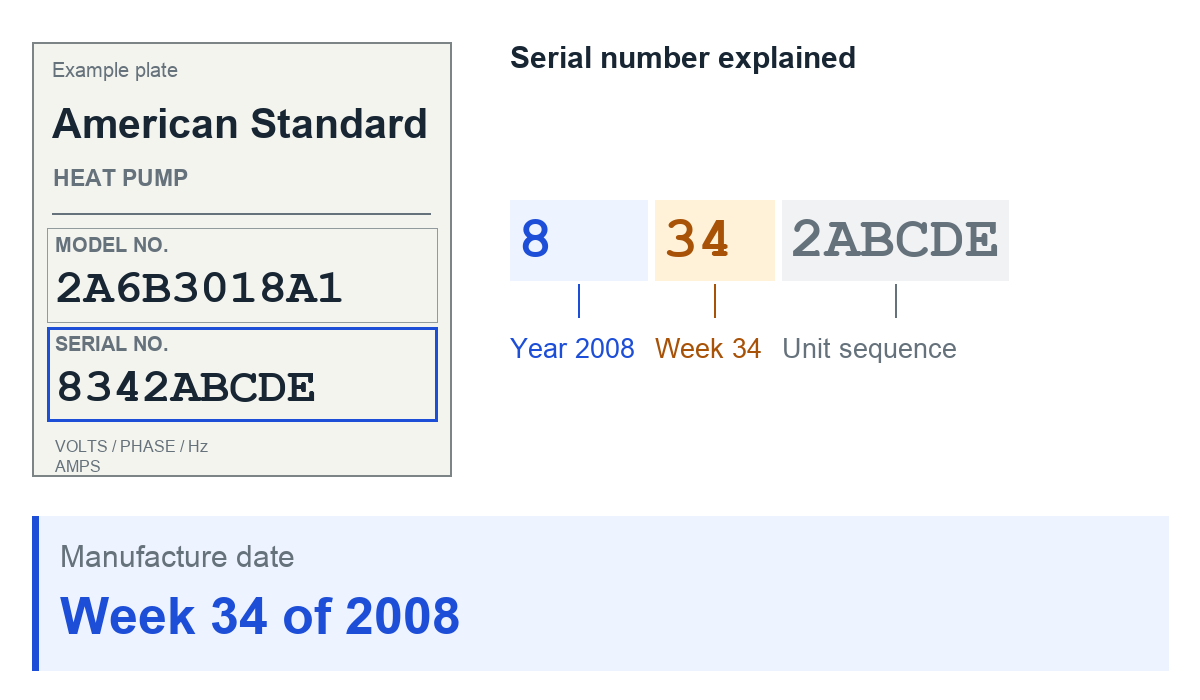
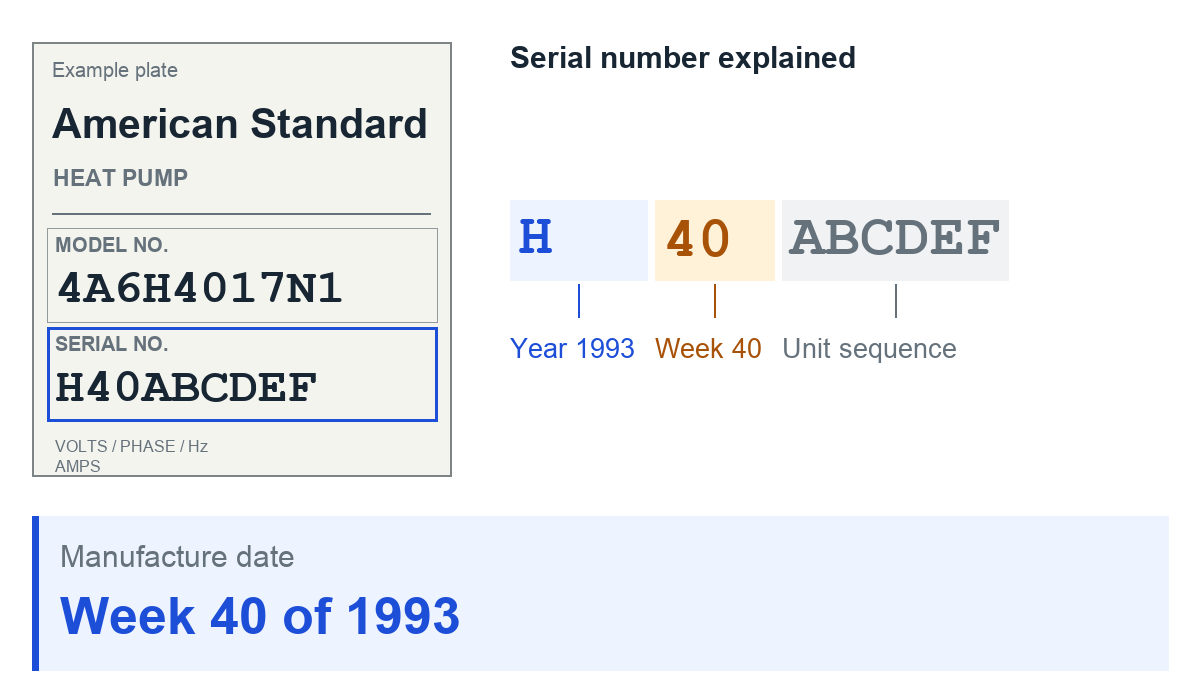
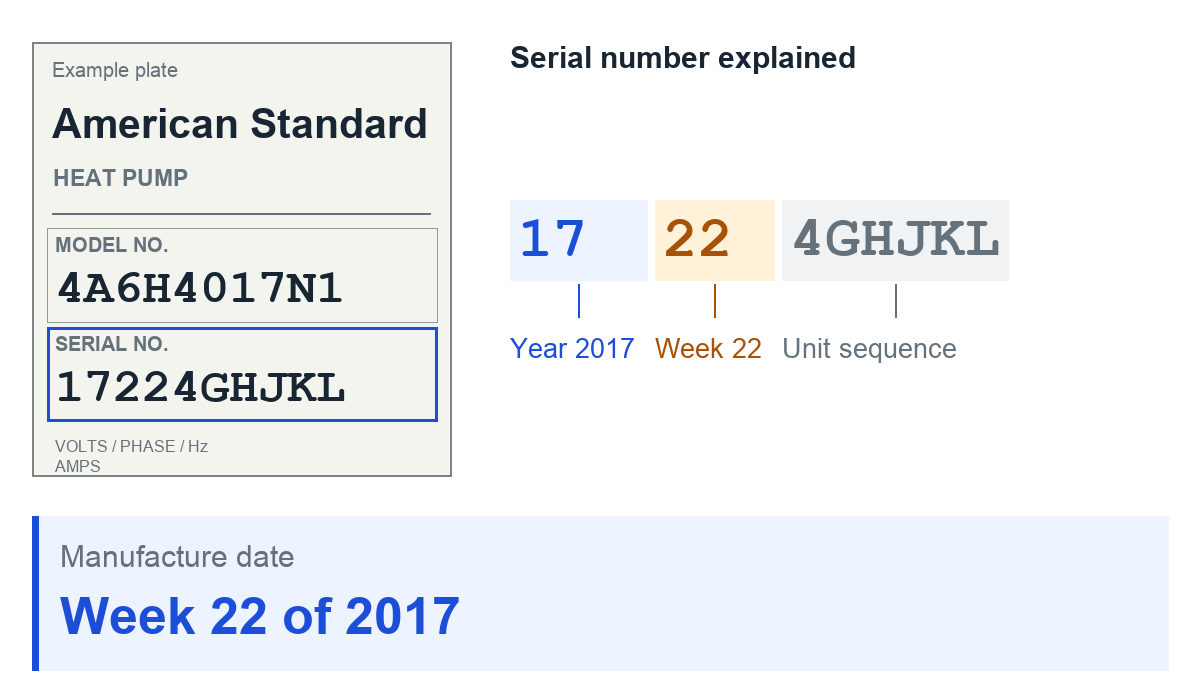
In the 2010-onward numeric structure, positions 1–2 are the two digit year and positions 3–4 are the production week. Serial number 17224GHJKL splits as 17 | 22 | 4GHJKL and means production week 22 of 2017. The characters after the date fields identify factory and unit details but do not influence the manufacture date. Appliage checks all three structures before returning the production week and estimated age.
A serial number that begins with four digits can sometimes match both numeric structures. For example, 2306ABCDEF can be split as 2 | 30 | 6ABCDEF under the 2002–2009 structure or as 23 | 06 | ABCDEF under the 2010-onward structure. Both years fit their respective periods, and both 30 and 06 are valid production weeks. Therefore, Appliage returns both production week 30 of 2002 and production week 06 of 2023. Entering the model number does not choose between the two dates.
Appliage decodes three American Standard date structures, and each gives a production week rather than a month. From 2010 on, the first two digits are the year and the next two are the week. From 2002 through 2009, the first digit is the year and the next two are the week. The older format starts with a year code and two digits for the week; L, M, N, 9, and Q also appear in the handbook’s separate horizontal furnace column.
A serial starting with L, M, or N can point to two older years until you know the equipment type. A serial beginning 906 can also mean 2009 under the standard structure with a one digit year or 1983 under the dedicated horizontal furnace column. Four digit openings such as 2306 have another kind of split: 2 | 30 means week 30 of 2002, while 23 | 06 means week 6 of 2023.
American Standard Serial Number Structures
- 1980–2001: 1 year letter
- 1980–2001: 2–3 production week
- 1980–1984: 1 horizontal furnace year code (L/M/N/9/Q)
- 2002–2009: 1 one digit year
- 2002–2009: 2–3 production week
- 2010+: 1–2 two digit year
- 2010+: 3–4 production week
- remainder factory and unit details
| American Standard date structure | Year field | Production week field | Example |
|---|---|---|---|
| 1980–2001 letter code structure | Position 1 | Positions 2–3 | H40ABCDEF = week 40 of 1993 |
| 1980–1984 dedicated horizontal gas furnaces | Position 1 (L, M, N, 9, or Q) | Positions 2–3 | Q061381FA = week 6 of 1984 |
| 2002–2009 numeric structure | Position 1 | Positions 2–3 | 8342ABCDE = week 34 of 2008 |
| 2010 onward numeric structure | Positions 1–2 | Positions 3–4 | 17224GHJKL = week 22 of 2017 |
All structures return a production week rather than a month. Every production week field must contain a value from 01 through 53. The characters after the date fields identify factory and individual unit details but do not influence the manufacture date.
Year Letters in the Standard 1980–2001 American Standard Structure
The published letter series is not in alphabetical order, so match the letter in the table instead of counting through the alphabet.
| Year letter | Manufacture year |
|---|---|
| O or A | 1980 |
| T | 1981 |
| U | 1982 |
| W | 1983 |
| X | 1984 |
| Y | 1985 |
| S | 1986 |
| B | 1987 |
| C | 1988 |
| D | 1989 |
| E | 1990 |
| F | 1991 |
| G | 1992 |
| H | 1993 |
| J | 1994 |
| K | 1995 |
| L | 1996 |
| M | 1997 |
| N | 1998 |
| P | 1999 |
| R | 2000 |
| Z | 2001 |
Z is the last year code in the standard column: digit years begin in 2002. I has no year in either column, and V is a plant code, not a year code. Q is absent from the standard column but means 1984 for dedicated horizontal gas furnaces.
Older Dedicated Horizontal Gas Furnaces
The second column on ACIN-3 of Trane’s 2026 Product Handbook is headed “Ducane Oil / Horizontal Gas Furnaces.” It gives L = 1980, M = 1981, N = 1982, 9 = 1983, and Q = 1984. Check the rating plate for the equipment type before choosing between the two older columns.
| Year code | Dedicated horizontal furnace year | Standard year, if also listed |
|---|---|---|
| L | 1980 | 1996 |
| M | 1981 | 1997 |
| N | 1982 | 1998 |
| 9 | 1983 | 2009 |
| Q | 1984 | — |
For L061381FA, Appliage lists week 6 of 1996 and week 6 of 1980 as two candidates. For 9061381FA, it lists week 6 of 2009 and week 6 of 1983, with 2009 first. Q061381FA gives week 6 of 1984 under the dedicated horizontal furnace column.
The same handbook column also lists two digit codes 85 through 99 for Ducane oil furnaces, and its footnote says Ducane serials made before 1996 carry the date code in the last four digits. Appliage does not decode either of those Ducane layouts.
Why Some Four Digit Openings Have Two Dates
For serial number 2306ABCDEF, the 2002–2009 structure splits it as 2 | 30 | 6ABCDEF: 2 means 2002 and 30 means production week 30. The 2010-onward structure splits it as 23 | 06 | ABCDEF: 23 means 2023 and 06 means production week 06. Both week values fall between 01 and 53, both years fit the period of the structure being tested, and the remaining characters are allowed in both structures. That is why Appliage keeps both dates.
American Standard Serial Numbers Appliage Cannot Find the Age
For an older year code structure, position 1 must appear in at least one of the two official columns. I has no year in either, and V is a plant code; Q appears only in the dedicated horizontal furnace column. For either newer numeric structure, the year digits must fit the stated year range. Every structure also requires a production week from 01 through 53. If the opening characters fail these checks, Appliage returns no manufacture date.
Appliage does not have an American Standard model production period catalog. A model number can help identify the equipment type, but entering it in Appliage does not choose between the two older columns, supply a missing year or week, or choose between two valid numeric splits. A dated installation, purchase, service, recall, or factory record may resolve the ambiguity.
The manufacture week can differ from the installation date and warranty start date. A unit can remain with a distributor or installer before it is placed in service.
Why Trane Appears on American Standard Records
American Standard HVAC equipment uses the same three main Trane year and week structures, and federal recall notices list the two brands together. The handbook’s separate column for dedicated horizontal gas furnaces can also apply where the equipment type matches. This guide applies only to heating and cooling equipment, not to other products that carry the American Standard name.
The Trane serial number lookup explains the same structures with Trane examples. Choose the name printed on the rating plate when an invoice and the cabinet use different brand names.
Sources
- Trane 2026 Product Handbook, ACIN-3. Its standard year code column and separate “Ducane Oil / Horizontal Gas Furnaces” column give the older year codes, including the shared L/M/N codes and 9 = 2009 or 1983 by layout. Archived copy.
- Trane warranty lookup
- CPSC: Trane and American Standard packaged unit recall (25-369)
- CPSC: American Standard heating and cooling unit recall (05-104). The notice explains which opening digits give the manufacture date.
For other brands, see our appliance serial number lookup.