Before trying to decode the serial number, read the complete brand name and identify the product type and country where it was sold. If the plate says White-Westinghouse, use the separate White-Westinghouse finder. Some later White-Westinghouse appliances have a ten-character serial number whose third character is the final digit of the year and whose fourth and fifth characters give the production week. This rule does not apply to every White-Westinghouse appliance, and it never applies to a plate that says only Westinghouse.
Which Westinghouse Serial Number Rule Applies?
| Rating plate or product group | What the serial number can tell you | What to do |
|---|---|---|
| Older U.S. Westinghouse Electric household appliance | These appliances use earlier numbering systems. No single published date table covers all of these older serial numbers. | Keep the model and serial number together and use a dated manual, service record, or manufacturer archive to identify the period. |
| White-Westinghouse household appliance with a matching ten-character serial number | On the WCI and Electrolux-era structure, position 3 gives the final digit of the year and positions 4–5 give the production week. The year digit repeats every ten years. | Select White-Westinghouse and enter the model number as well, because the model may identify the correct decade. |
| Earlier White-Westinghouse appliance | Not every White-Westinghouse appliance uses the ten-character rule. For example, some 1977 refrigerators used three opening letters followed by five numbers. | Do not force the later year-and-week rule onto a shorter or differently arranged serial number. |
| Australian or New Zealand Westinghouse appliance | These appliances belong to the regional Electrolux product system and use model, PNC, and serial identifiers that differ from the U.S. White-Westinghouse structure. | Record the model, PNC, and serial number. Do not use the U.S. White-Westinghouse table. |
| Westinghouse HVAC equipment | HVAC equipment follows its own manufacturer and product-family rules. | Use the HVAC rating plate and the corresponding HVAC brand guide. |
| Modern Westinghouse generator, television, electronic product, or licensed appliance | The serial-number structure depends on the company that made that product. | Identify the product category and responsible manufacturer before trying to find the age. |
A plate that says only Westinghouse does not tell you which row applies. You also need the product category, country, and model number before choosing a date coding method.
Age Decode Examples
The example below is a White-Westinghouse washer, not a bare Westinghouse appliance. It shows why the complete brand name and model number must be checked before the serial number is decoded.
White-Westinghouse Serial Number Example 1: XC90306228
The model number is WWS833FS. Appliage returns production week 3 of 2009 (Estimated) and an estimated age.
- Split serial number XC90306228 as X | C | 9 | 03 | 06228.
- X is the manufacturing-location code, and C identifies the product as a washer.
- The number 9 is the final digit of the manufacture year. Because this year code repeats every ten years, the serial number alone can point to 1999, 2009, or 2019.
- The digits 03 mean production week 3. The final five digits, 06228, identify the individual washer and do not influence its manufacture date.
- A 2009 U.S. Consumer Product Safety Commission notice lists model WWS833FS in the serial range beginning with XC90306228. The model and serial number together select 2009 from the three possible years.
Therefore, the washer was manufactured in production week 3 of 2009.
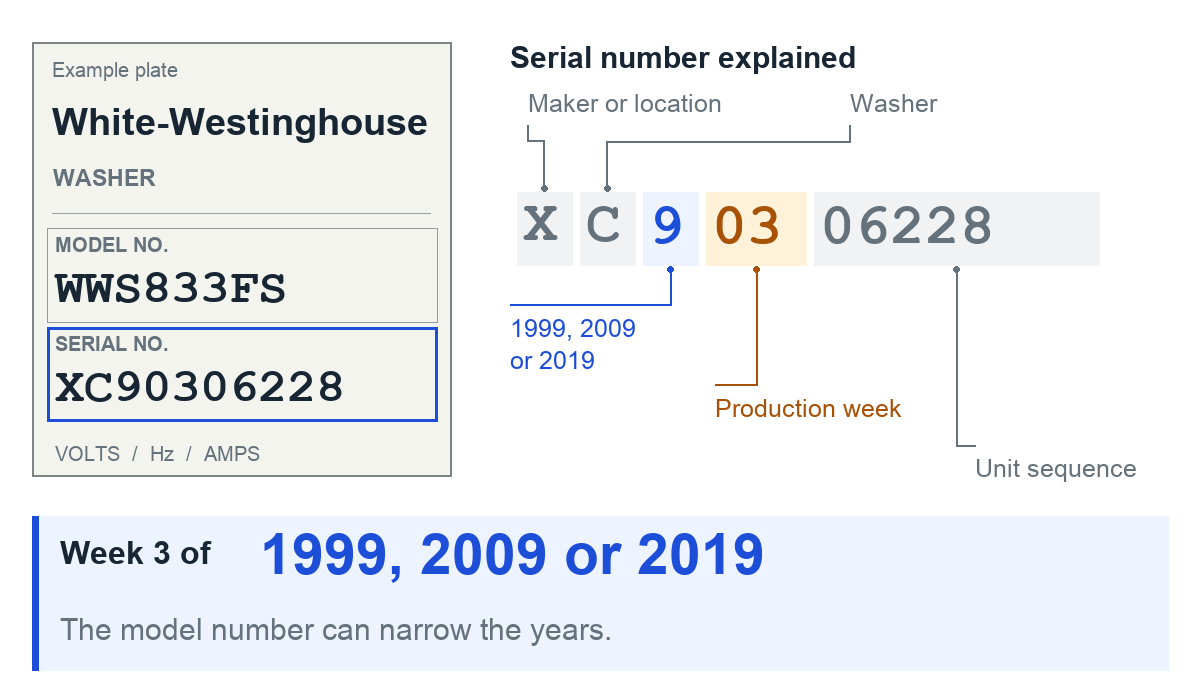
This example can be decoded only because the rating plate carries the full White-Westinghouse name. Entering the same characters under Westinghouse would return no manufacture date.
Westinghouse Serial Numbers Appliage Cannot Find the Age
Appliage cannot find the age from a rating plate that says only Westinghouse when the product’s manufacturer and serial-number system cannot be identified. The White-Westinghouse household-appliance rule also cannot be used for older Westinghouse Electric appliances, Australian or New Zealand appliances, HVAC equipment, generators, televisions, electronics, or other licensed products.
A purchase, installation, warranty, or service date can help establish the period in which an appliance was used. Do not treat any of those dates as the manufacture date unless a model or serial record connects it to the appliance.
Why Westinghouse and White-Westinghouse Are Separate
Westinghouse’s major-appliance operations became part of White Consolidated Industries in stages by 1975, and later household appliances used the White-Westinghouse name. Electrolux acquired White Consolidated Industries in 1986. This history explains the relationship between the names, but it does not make their serial-number systems interchangeable.
A 1977 White-Westinghouse refrigerator notice lists serial numbers beginning with RUD, RUE, RUF, and other three-letter groups followed by five numbers. Later 1997 and 2009 records show ten-character White-Westinghouse serial numbers with a year digit and production week. The appliance’s period and complete serial structure therefore matter even after the White-Westinghouse name has been confirmed.
If the plate carries the full later name, continue with the White-Westinghouse serial number lookup.
Sources
- CPSC: Frigidaire washer recall (09-292). White-Westinghouse WWS833FS is included with serials XC90306228–XC91606302.
- CPSC: WCI gas range recall (1997). The notice lists ten character serials and a 1997 sale period.
- CPSC: White-Westinghouse refrigerator repair program (1977). The older refrigerator serials begin with three letters.
- Electrolux: Westinghouse in Australia and New Zealand. Electrolux describes its Australian appliance business.
- Westinghouse company history. Westinghouse describes the partners involved in manufacturing and product development.
For other brands, see our appliance serial number lookup.